
A Guide to Must-Visit Attractions near Atyrau
For many, the Atyrau region is synonymous with oil, and that stereotype often overshadows its hidden gems. Yet this corner of Kazakhstan brings together ancient cities, chalk plateaus, deserts, and quiet lakes, turning even a short trip into a small adventure. In this article, we’ll show you where to go near Atyrau to uncover traces of past civilizations and discover nature’s unexpected contrasts.
Natural Wonders
One of the most striking places in the Atyrau region is the Akkegershin Plateau, a stark reminder of the ancient ocean that once covered western Kazakhstan. When the waters withdrew, they left behind thick layers of limestone and chalk. Over millions of years, wind and erosion shaped them into snow-white cliffs, ridges, and canyons. A little farther east, on the border with the Aktobe region, rise the Aktolagay Mountains. They’re made of the same chalk formations but towering higher.
About 190 kilometers (118 mi) north of Atyrau lies Lake Inder, a salt lake whose shimmering white shores are coated with a crust of minerals. Its waters contain bromine, magnesium, lithium, potassium, iodine, chalk, and even traces of rubidium. The local mud is believed to help with skin and joint conditions. Lake Inder isn’t a spa destination though. There’s no infrastructure or designated swimming areas. Still, the snow-white scenery makes for extraordinary photos.
Between Akkegershin and Aktolagay sits the former Munaily Mola bitumen deposit. Once an active industrial site, it has long been abandoned. Bitumen still seeps to the surface, forming dark, rounded boulders that resemble the spherical stones of Mangystau’s Torysh Valley. The spheres in Torysh are ancient, formed millions of years ago at the bottom of the Tethys Ocean. Here, their “younger cousins” are born not of geologic epochs but of sun and slowly rising bitumen.
Not far from Akkegershin is the Imankara Cave, around 25 meters deep (82 ft). Marks from stone tools are still visible on its walls, showing that the people who once lived here tried to expand their shelter. The site was inhabited from the 5th to 3rd millennia BC and later during the Middle Ages. In 1911, the cave was the field base of engineers led by Alfred Nobel, who worked on oil and gas exploration in western Kazakhstan. During World War II, the cave witnessed yet another dramatic event. In 1944, German soldiers who landed in the area hid inside it and were killed in a fierce firefight with NKVD operatives.
The most unusual natural site in the region is the Valley of Lotuses, located where the Kigach and Sharonovka rivers flow into the Caspian Sea. This is the only place in Kazakhstan where lotuses grow, and it’s also the northernmost point on the planet where these flowers bloom. Their peak season runs from mid-July to late August. To reach these rose-colored fields, you’ll need to travel about 300 kilometers (186 mi) from Atyrau and then continue a few more kilometers by boat from the village of Kurmangazy (Ganyushkino). The journey isn’t easy, but witnessing this rare spectacle more than repays the effort.
Not far away, near the Russian border, lies the Besshoky Upland. It’s a flat plateau raised 30-40 meters (100-130 ft) above the surrounding terrain. Its surface is scattered with gypsum mounds and odd-shaped formations. Beneath it stretch karst caves such as Kenenbay Cave. It’s important not to confuse this plateau with the mountain of the same name in Mangystau. The names match, but the landscapes couldn’t be more different.
North of Besshoky spreads the Naryn-Kum Desert. This is a true desert with rolling dunes and clean reddish-yellow sand. People lived here long ago, and archaeologists continue to find pottery fragments, arrowheads, and even human remains.
Farther out, deep in the steppe, on the border of the Atyrau, Aktobe, and Mangystau regions, rise the Sholkara Mountains. Shark teeth, mollusk shells, and fish vertebrae are often unearthed here. At one point, paleontologists even discovered the bones of an Embasaurus – a two-legged predatory dinosaur that once roamed this territory.
Near the town of Kulsary, lies Lake Kamyskol. There used to be a park nearby, now abandoned, but the northern shore is still a pleasant spot for rest. It boasts sandy beaches, a health resort, and several guest houses.
Historical Landmarks
The history of the Atyrau region is just as compelling as its landscapes. It reveals itself in places where trade once flourished, armies clashed, and the fate of entire peoples shifted. The most important monument of that past is the ancient city of Saraishyq. This settlement served as a key trading hub linking Khwarazm, the Caucasus, and Russia. It emerged in the 13th century during the Mongol invasion and, by the 14th-16th centuries, became a political center and temporary capital of the Kazakh Khanate. Today, the site is home to the Saraishyq Historical and Cultural Museum-Reserve, where visitors can see reconstructions of a khan’s headquarters along with collections of archaeological finds.
Not far from the Akkegershin Plateau lies the underground Akmechet Mosque, built by Beket Ata – the revered 18th-19th century Sufi mystic, educator, and healer. Akmechet is one of the key sites associated with his spiritual legacy. The mosque itself consists of two underground chambers joined by a corridor. Above ground, a small complex includes a functioning mosque and a large necropolis where Beket Ata’s grandfather, father, mother, and son are buried. Beyond Akmechet, Beket Ata founded several other underground religious structures in Mangystau, all of which became important destinations for pilgrims.
On the way to Akmechet, travelers pass another underground mosque – Kulshan Ata. It was created by Kulshan, Beket Ata’s nephew and disciple. Over time, a necropolis grew around the site. Today, this sanctuary preserves the echoes of a spiritual tradition that has endured for centuries.
Just 4 kilometers (2.5 mi) from the Kulshan Ata Mosque lies the Araltobe burial-mound complex. Here, researchers uncovered a richly furnished burial believed to belong to a Sarmatian chieftain and his wife. Hundreds of gold plaques, arrowheads, a severely corroded damask sword, and a royal staff were found alongside the remains. The discovery was so important that it became known as Kazakhstan’s “second Golden Man.”
Near the village of Akkystau stands Taskran, a 19th-century tower whose original function remains uncertain. One theory suggests it marked the boundary between the Bukeyev Horde and the Ural Cossacks. Another proposes it served as a beacon for fishermen lost in fog or storms. Back in the 19th century, the waters of the Caspian Sea reached nearly as far as the present-day Atyrau-Astrakhan highway.
The village of Dossor holds a special place in the region’s history. Oil exploration began here in the late 19th century, and in 1911 oil was finally found. That same year, the field and its workers’ settlement were officially established. It became the first oil development site in Kazakhstan.
This article doesn’t cover the attractions of the regional capital, Atyrau. For those, see A Guide to Must-Visit Attractions in Atyrau. Together, the two articles offer a complete look at the region and help you plan your own route with ease.
Recommended tours:
All offers_420x650_4ab.jpg "Mangystau Mysteries Off-Road Tour")
On request
Join us on a jeep tour around Mangystau, known for its vast desert plateaus, unique rock formations, and cultural heritage sites. This tour is a blend of adventure and spirituality, revealing the heart of Kazakhstan's wild west.
-1_420x650_4ab.jpg "Sunny Land of Mangystau Tour")
On request
The Mangystau region of Kazakhstan harbors a wealth of historical mysteries and natural marvels. From ancient burial sites to towering buttes, Mangystau never ceases to amaze. Don't miss the opportunity to unravel the secrets of this sunlit land!
_420x650_4ab.jpg "Mysteries of Tyub-Karagan One-Day Tour")
In just one day, you'll see some of Mangystau's most remarkable landmarks, including an ancient mosque, limestone canyons, a valley strewn with perfectly round stones, a lake inhabited by relic turtles, and more.
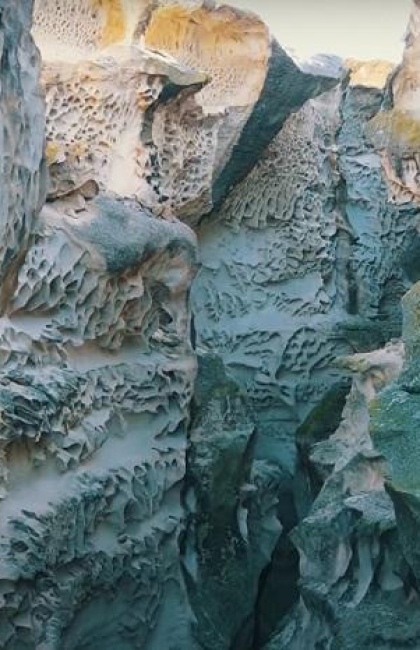
Visitors often compare this canyon's porous surface to delicate lace, aerated chocolate, sea corals, or intricately patterned honeycombs.
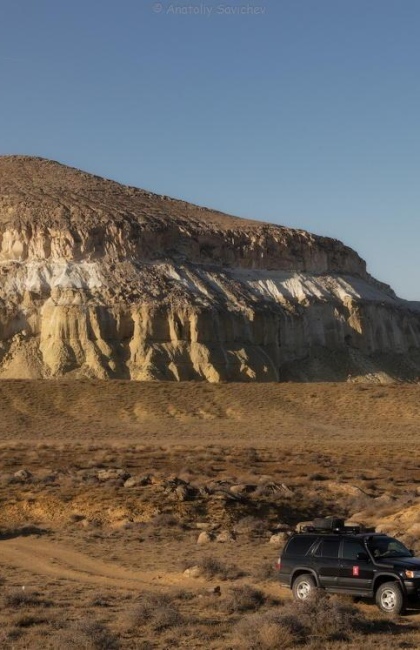
The Tyub-Karagan Peninsula boasts some of Mangystau's finest attractions, ranging from an ancient cave mosque to enigmatic globular stones. Spend just one day unraveling the secrets of this captivating region.