Nurullabai Palace
Khiva is mostly known for the Itchan Kala, yet one of the city's most fascinating attractions lies just outside its walls. The Nurullabai Palace blends ancient Khorezmian architecture with early 20th-century European-style interiors. Inside visitors can see grand reception halls decorated with mirrors, gilded stucco, tiled stoves, and chandeliers. The interiors look more like royal residences of St. Petersburg rather than a Central Asian palace.
From a Garden to a Khan’s Palace
Construction of the palace began in the early 20th century during the reign of Muhammad Rahim Khan II. The ruler wanted to build a new residence for his son, Asfandiyar.
The khan chose a site on the outskirts of Khiva, where a large garden was located. The garden belonged to a man named Nurullabai. He agreed to sell the property to the khan, but only on the condition that his name be preserved. Muhammad Rahim Khan accepted, and the name Nurullabai remained associated with the land. It eventually became the name of the palace as well.
Major construction took place between 1904 and 1906 and continued even after Muhammad Rahim Khan’s death. Asfandiyar Khan, who succeeded his father as ruler of the Khiva Khanate, ordered the construction of a separate building for official receptions. This structure was completed in 1912.
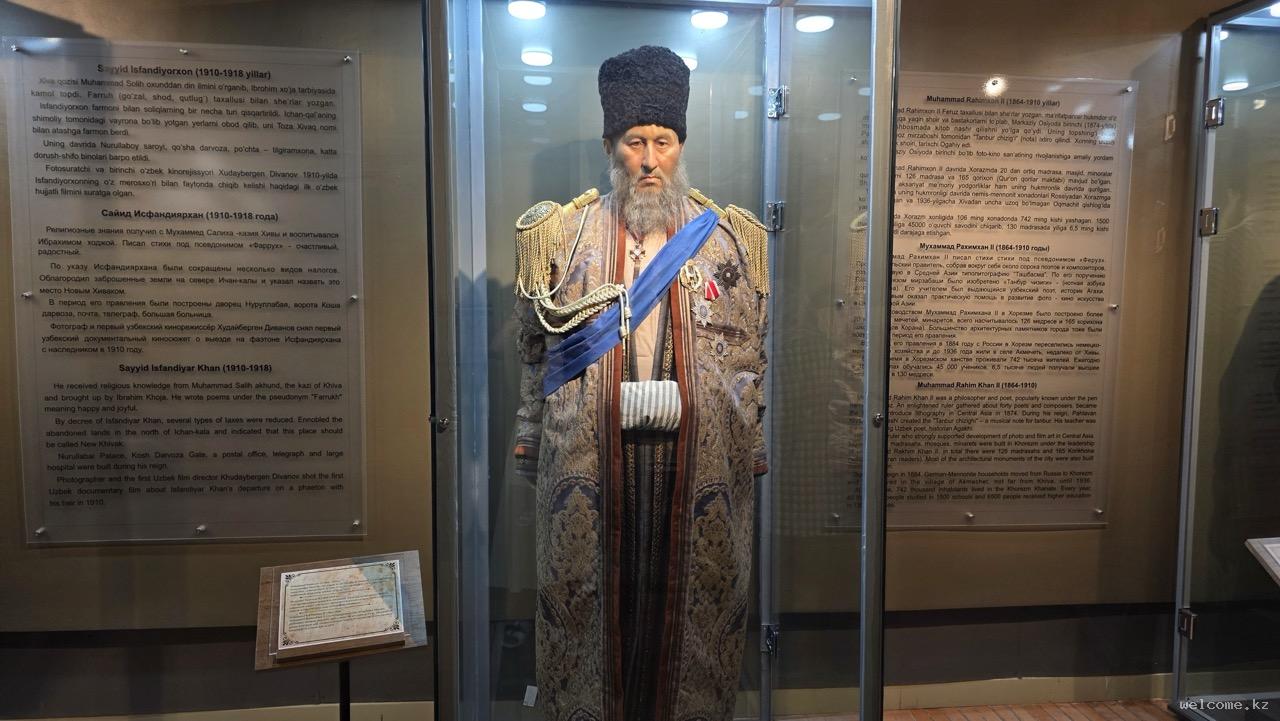
Asfandiyar Khan ruled from 1910 to 1918, and the Khiva Khanate survived until 1920. Nurullabai Palace therefore belongs to the very last chapter of the khanate’s history. After the Soviet regime was established, the palace no longer served as the khan's residence.

East Meets West
Nurullabai stands out from most of Khiva’s palaces as it blends traditional Khorezmian architecture and European-style interiors.
Local craftsmen worked on the palace together with specialists from Russia and Europe. Some materials, furniture, and decorative elements were also manufactured in St. Petersburg.
The throne room makes the strongest impression. Tall doors, large mirrors, stained-glass windows, parquet floors, and glazed tile stoves contribute to a style that is highly unusual for Khiva. The ceilings are richly decorated with painted designs and complex geometric patterns.
The European character of Nurullabai Palace reflected the growing influence of the Russian Empire in the region. Muhammad Rahim Khan II visited St. Petersburg several times and was impressed by its grand palaces. Inspired by what he saw, he brought some of these ideas back to Khiva. That is how European design features gradually found their way into the Khiva court.
Gallery